National Air Quality Day: RAFU lists the 20 most polluting departments in France
Every year, 40,000 people die prematurely in France due to fine particulate matter. This silent tragedy is partly (between 30 and 50%) attributable to ammonia, this invisible gas from factory farming that poisons our air and our bodies. By combining with other pollutants, it forms deadly particles (PM2.5) responsible for asthma, cardiovascular disease, and cancer. And yet, nothing changes.
On this National Air Quality Day, with ammonia now the second leading cause of preventable death in our country, RAFU denounces the lack of regulation of factory farming, the main source of ammonia emissions.
We refuse to allow the right to breathe clean air to be sacrificed on the altar of agribusiness. It is time to act: regulate, reduce, and convert. 40,000 deaths per year linked to fine particulate matter, the second leading cause of preventable death in
France: ammonia is a major public health issue. Air quality is a major public health issue: 40,000 deaths per year are attributable to fine particulate matter.
Ammonia is one of the three main contributors to the formation of fine particulate matter responsible for asthma, allergies, respiratory and cardiovascular diseases, and cancer. Nitrogen oxides emitted by road traffic and nitrogen dioxide from the heating sector (coal and fuel oil) are also responsible.
Industrial livestock farming is the primary sector responsible for air pollution due to ammonia emissions.
An analysis of fine particulate matter emissions in 2020 is extremely concerning: for PM2.5 particles, the daily average of 15 μg/m³ should not be exceeded more than 3 to 4 days per year. As for the annual average for these same particles, it should not exceed 5 μg/m³. The study by the Brittany Against Factory Farms campaign, focused on Brittany, highlights that in 2020, the WHO guideline values were exceeded 62 times in Lorient, 59 days in Vannes, 53 days in Rennes, 37 days in Brest, and 16 days in Merléac, placing public health at serious risk. The 2020 lockdown period underscored the significant responsibility of the agricultural sector.
The year 2020 presents an exceptional opportunity to pinpoint the source of fine particulate matter in Brittany. During this period, the halt in road transport and exceptionally warm ambient temperatures, which minimized the use of wood-burning boilers and stoves, limited air pollution sources to manure from livestock farms. However, despite this reduction in the heating and road transport sectors, pollution levels were significantly exceeded. More than 97% of ammonia emissions originate from agriculture. Images from European satellites monitoring this pollutant in real time for the past seven years leave little room for doubt: in March and April, during the spreading of liquid manure, solid manure, and synthetic fertilizers, the most affected departments turn red.
Hamaoui-Laguel et al. reached the same conclusion in 2014: “A significant contribution of ammonium nitrate (NH4NO3) to fine particulate matter peaks is often observed in early spring, during periods of livestock effluent and fertilizer spreading.” Ammonia (NH₃) is indeed a volatile gas produced by the decomposition of urea and nitrogenous matter present in animal excrement (urine, droppings, slurry, manure). When effluents (slurry or droppings) are stored, handled, or spread, the nitrogen they contain is partially transformed into ammonia, which escapes into the air. In simplified chemical terms, the urea in animal excrement is transformed into ammonium/ammoniacal nitrogen (NH₄⁺) and then into ammonia (NH₃, gas).
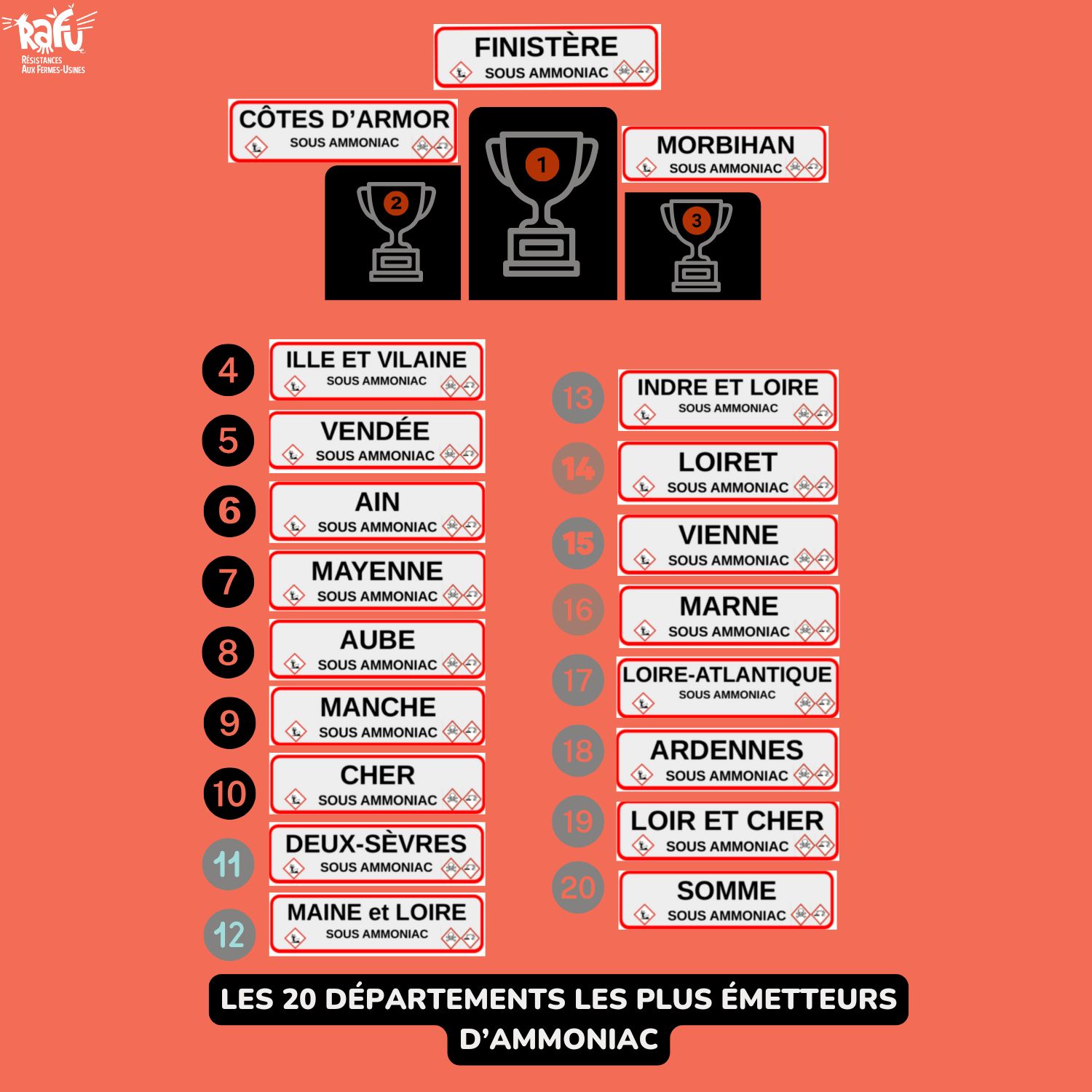
Ammonia: ranking of the 20 most ammonia-polluting departments in metropolitan France
Read the full article in French.