Denmark proves ending animal factories is possible
Here’s how, and why other European countries should follow.
After years of people campaigning, the newly formed Danish government has committed to reshape agriculture from intensive, polluting pig production to a system that protects animal welfare, rural communities, and nature.
During the election, pig farming was one of the dominating issues across the country. After two months of coalition talks, the four-party government set out the following manifesto for farming:
“We are driven by a determination to be the greenest government. The Danes’ drinking water must be clean. And we are committed to making decisions that safeguard future generations’ right to clean Danish groundwater. Danish agriculture must be produced and developed in a way that better protects the surrounding natural environment. Greater consideration must be given to neighbours and the local community, and animal welfare for pigs must be significantly improved.”
A broad alliance against pig factories made this shift in narrative possible, with NOAH/Friends of the Earth Denmark supporting the National Association Against Pig Factories in getting the perspectives of neighbours to pig factories heard and listened to. By organising closely with rural communities, people suffering the consequences of pig factory expansion and the resulting pollution of their air, drinking water and quality of life have been able to share their stories in national media, challenging the narrative that this solely a Copenhagen-only issue.
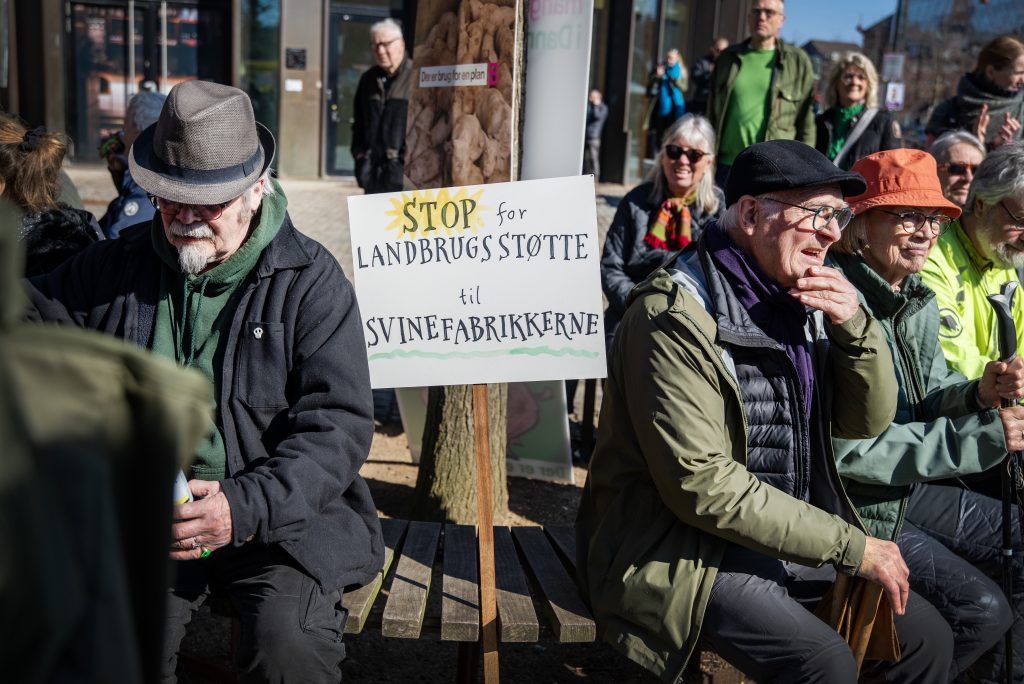
Copenhaguen Demo for et svinevalg 22. marts 2026 (c) Dyrenes Beskyttelse
” For several years I have seen the immense consequences of the constant expansion of pig farms, and I had lost all hope and trust in our government and municipalities ”
Ziff Hansen, neighbour of one of these many pig factories operating in the country, told us.
“... So I literally CRIED when I saw the broadcast about our new government! I sincerely hope that they will follow through on their intentions and work for a better life in the countryside for humans as well as animals: with small-scale and local farming made easier for everyone and hence expansion of biodiversity, nature, clean air and water – which are the reasons why most of the citizens in the countryside moved ‘out here’ in the first place.”
Concretely, the government announced the following measures:
- An immediate moratorium on new pig factories and expansions until a plan for production has been drawn up
- Giving back to municipalities their right to refuse applications for pig factories
- Implementing a lower limit for nitrate levels in drinking water – from 50 mg/l to 6 mg/l
- Redistributing agricultural subsidies to benefit smaller farms and producers, as well as nature and the climate
- A long-term goal that Danish pig production primarily raises pigs for the country’s own food supply, or that can be processed domestically before export
- A ban on the use of pesticides in vulnerable groundwater-forming areas
- Compliance with the Animal Welfare Act, with a particular focus on ending the tethering of sows and tail docking by 2030 at the latest
- A transfer of responsibility for animal welfare supervision to the Ministry of Justice
- A revision of the Planning Act so that the agricultural sector does not have priority over the entire land area of Denmark
- Applying the polluter pays principle to agriculture
This system change approach has long been advocated for by Stop Factory Farming Europe’s partners NOAH/Friends of the Earth Denmark and the National Association Against Pig Factories. And is now official government policy thanks to their huge mobilisation efforts, and to the thousands of people who spoke out, organised and made this happen.
Copenhaguen Demo for et svinevalg 22. marts 2026 (c) Dyrenes Beskyttelse
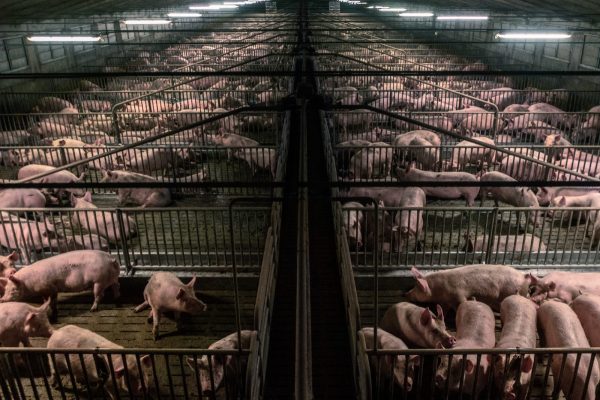
This is a huge win, especially for a country that has been the home of ultra-intensive agriculture, with the most developed integrated production system. Denmark produces more meat per capita than any other country in the world, with 320 kg per person. ‘Farms’ producing more than 5.000 pigs grew from 198 in 2000 to 940 today. While 75 % of Denmark’s agricultural area is used for growing animal fodder, the country has the lowest amount of protected natural areas in the EU.
If Denmark can change, so can other countries in Europe. This is a wake-up call to those who have followed a similar toxic path of industrial livestock expansion – like Spain and France. Time to follow suit and defend European laws that protect people and the environment.